THE WORLD OF A.C.E. FIRETEAM
Some time in the late 21st century, a slow economic shift has moved much of the traditional power structure away from federal governments and into the hands of large corporations. As governments lose power and solvency, the private sector has swept in and increasingly taken over distribution of necessary services and security. The shift towards privatization increases both stability and inequality on a global scale. National military are largely replaced by private security firms owned or hired out by corporations, and skirmishes over territory and resources are commonplace.
Most 'non-essential' functions of government have long since lapsed due to lack of funding, as a result of this, the monitoring of near-earth objects is largely ignored, and the approach of the Tiamat asteroid cluster went unnoticed until far too late. The initial impact of Tiamat 001 caused catastrophic damage over a large percentage of the globe. Tsunamis devastate coastal areas, and the depth of impact of the initial cluster causes extensive seismic disruption on all major land masses. Amid the chaos of this global crisis, the remaining governments are largely abandoned as ineffectual, and the surviving corporate structures provide shelter and supplies to those they can integrate into their workforce.
The dust clouds and debris scattered throughout the atmosphere create a nuclear winter-like effect around the globe as temperatures drop, and an unexpected side effect of the cloud is a wholesale disruption of the emf bands, effectively disabling most forms of long-range communications. The dust particles are studied and are noted to contain significant traces of an unknown mineral dispersed from the asteroid dubbed 'tiamatium'. This heavy metal has several unique properties, giving off a specific type of radiation that can be easily harnessed for a power source, while being significantly less harmful than traditional nuclear sources.
The implications of this new power source lead to global expeditions to find and retrieve any meteor fragments as a potential new and abundant fuel source to replace the shattered infrastructure around the globe. The continued seismic activity due to the damaged tectonic plates, often refereed to as ‘The Shattering' cause major issues with land-based travel; sinkholes and weakened ground as well as semi-regular fissures create extreme hazards for and long-range transportation. Except in a few mostly stable channels, rail travel is effectively impossible, and wheeled vehicles are no longer viable over long distances. Roadwork is destroyed by the shifting ground faster than it can be laid down. Another unexpected side-effect of the tiamatium particle cloud is the volatility of the mineral effectively neutralizing most forms of conventional air travel. even a few particles pulled into the intake of a jet engine may cause a catastrophic explosion. Specific low speed shielded rotor based aircraft are eventually designed to be able to travel in the new environment.
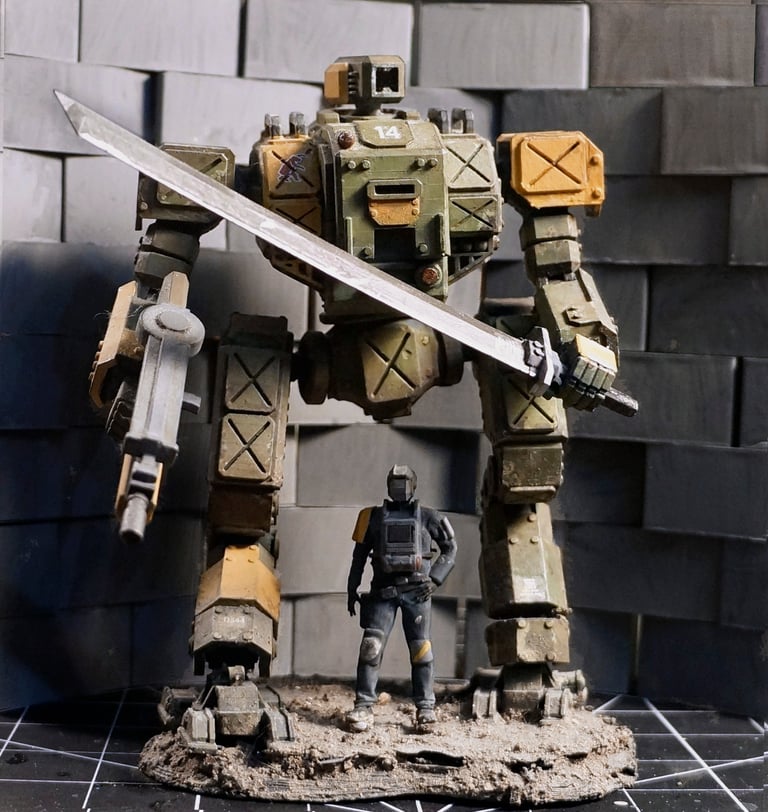
The treacherous landscape resulted in the increased use of ACE suits (Armored Construction Exoskeleton), a bipedal mobile vehicle that can effectively navigate uneven and unstable terrain, with high mobility and even weight distribution that allow it to effectively reach areas inaccessible to traditional vehicles. Originally designed for construction and salvage work, the ACE units are quickly tasked with the recovery of highly valuable tiamatium fragments whenever they are detected. The impact sites of these meteors are highly unstable due to the hyper-dense material's impact effects on local tectonics, as well as the increased radiation given off by the material.
Multiple corporations send out units to collect these fragments, skirmishes between competing recovery teams inevitably occur. Initial combat with the ACEs not designed for such functions is ineffective and brutal, often resulting in the loss of most or all combatants. Pilots begin adding improvised weaponry, welding on armor plating, and bolting salvaged military weaponry on to the frames of the ACEs to offer some protection while on recovery missions. These modifications do not go unnoticed, and soon companies began manufacturing purpose-built, multi role combat ACEs (Armored Combat Exoskeleton) to increase survivability and lethality which gives them a greater ability to penetrate contested areas and make effective recovery.
During this initial arms race, engineers at Kuro Heavy Industries begin integrating a specialized 'pilot frame' of depleted tiamatium plates around the cockpit, the hyper-dense metal proves impervious to all but the most lethal of attacks, shrugging off even top of the line armor piercing weaponry. This greatly increases the survivability and effectiveness of ACE pilots, and is soon implemented by Kuro's rivals as well.
Due to the rarity of the metal, typically only very limited plating is made of tiamatium, with the rest of the vehicle being protected by conventional armor, but the ability of the units to take a beating and finish the mission is an undeniable advantage. Several pilots started fashioning large melee weapons that are more effective at penetrating gaps and joints in the pilot frame, allowing for brutal hand to hand combat to effectively finish what ranged weapons can't. Each pilot works up a custom program of different martial forms, trying to gain the edge in close quarter combat with limited inputs available on the unit.
The Tiamat asteroid cluster has been pulled into a near-synchronous orbit with earth, and small to medium sized meteor impacts are still a common occurrence. When a meteor impact occurs, any nearby corporate forces will be scrambled, along with an increasing number of mercenary guns for hire to retrieve the valuable resource. A system of line-of-sight laser based communication relays and colored flares launched from units in the wasteland alert nearby units to converge on the nearby impact site, where increasingly vicious combat can occur to claim the prize. Pilots are chosen from the workforce of their parent corporation through various aptitude and psychological screenings, as well as volunteers hoping to improve their station in the hierarchical societies they live in. Often, for labor class individuals, the independence and begrudging respect that can be earned as a combat pilot is the only way to improve their station in society. While limited, scattered colonies of 'wastelanders' survive or even thrive outside of the corporate structure, most of the population are now inextricably tied to the system of the corporation under which they are born.